
Survey first: $300–$750
A recorded camera run with distances marked. Yours to keep, and usually credited if the work goes ahead.
Relining turns a recurring drainage problem into a finished one. The joints that roots come through are sealed along the whole run, so there is no way back in, and nothing above the pipe gets disturbed to do it.
Relining is a structural repair, not a cleaning method, and the distinction matters when you are comparing quotes. Jetting restores flow through a pipe that is still cracked. A liner restores the pipe.
That also means it is not always the answer. It cannot correct a run that has sagged or lost its fall, and it has nothing to line against where a section has collapsed. A camera survey separates those cases in about an hour, and the answer changes the cost by a multiple.

Water tracks along beams and slab falls, so the lot reporting the damage is often nowhere near the lot with the fault. Opening ceilings on a guess is how a small repair becomes three angry owners.
Camera and non-destructive location come first for exactly that reason. Once the defect is located and measured from a known point, the repair is a defined job and the liner goes in without exploratory demolition.
A listing does not stop you repairing a drain. What it restricts is change that is visible or that disturbs significant fabric, which is precisely what a trenchless repair avoids.
In practice that makes relining the path of least resistance on a listed or conservation-area property: nothing is removed, nothing changes above ground, and there is no reinstatement to get approved.
Kitchens along Oxford, Stanley and Crown streets pour fat and food waste through undersized old pipes, building thick grease chokes.
For a shop, café or clinic the real cost of a drainage repair is rarely the invoice. It is the days the doors do not open, and an excavation through a floor or a car park is measured in days.
A liner is installed from an existing access point and cures in hours, which is why commercial work is so often scheduled overnight or across a single closed day. The trading interruption is usually the deciding factor, not the price per metre.
Where the water table sits close to the pipe, every open joint is an entry point. The line runs fuller than it should year-round, silt comes in with the water, and the system behaves as though it is undersized when it is simply leaking inward.
Darlinghurst falls sharply toward Rushcutters Bay and Woolloomooloo, and storm surges through tight lightwell and lane drains overwhelm them quickly.
Sealing the run changes that immediately, and it is one of the clearest before-and-after results relining produces. It is also the case most often missed, because nothing looks broken from the surface.
Darlinghurst crowds onto a ridge in Inner Sydney (postcode 2010), bounded by Surry Hills, Paddington and Potts Point, its Victorian terraces and art-deco flats stacked along some of the city’s oldest streets. Dense living on century-old sewers means blocked drains are simply part of the deal here.
Excavating on a slope is a different job from excavating on the flat. Access for a machine is often impossible, the spoil has to go somewhere, trench walls need support, and reinstating a tiered garden or a retaining structure can cost more than the drainage work it was dug for.
Relining sidesteps all of it. The line is repaired from an existing access point, and the surface above stays exactly as it is. On a difficult block the saving is not marginal, it is often the difference between doing the job and deferring it.
The terraces off Victoria Street and Womerah Avenue still drain through century-old shared lines whose joints crack, drop and snag waste.
On a period property the drainage repair is rarely the expensive part. Tessellated verandah tiles, original brick paving, a mature garden or a heritage-listed frontage all cost far more to reinstate than the pipe underneath costs to fix.
That is the argument for trenchless in one sentence. The liner is drawn through an existing opening and cured in place, so the surface above is never disturbed and there is nothing to match, replace or explain to council.
A recorded camera run with distances marked. Yours to keep, and usually credited if the work goes ahead.
The prevailing 2026 Sydney range for residential sewer relining.
Proportionate for one fault in a sound run. We will recommend it over a full liner when that is what the camera shows.
For a run failing along its length, which on old clay is the common finding.
Plus reinstatement. On a bare lawn it can win. Under anything you would miss, it usually does not.
These are market ranges, not our price. Nothing is quoted before the survey, and nothing starts before you agree it. Figures here are indicative of the 2026 Sydney market rather than a quote from us, you get your own number as a fixed price before any work starts.

A CCTV survey establishes the material, the diameter, where the defects are and how far they sit from the access. You see the footage, and it is what the quote is built from.
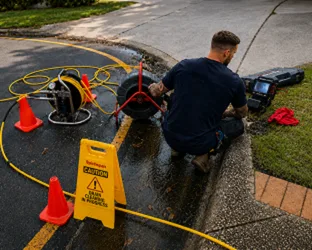
Patch or full length, and occasionally excavation instead. We will tell you when digging is the better answer even though it is the bigger quote.
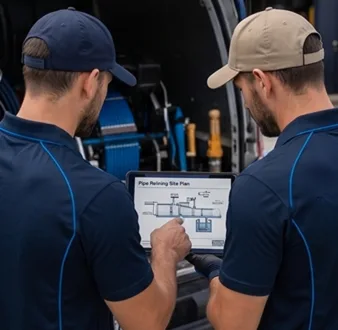
The run is jetted so the liner bonds to pipe rather than debris, the liner is installed through the existing access, and it cures in place. Most domestic jobs are a single day.

Every branch the liner passed is reopened from inside, then the run is cameraed again so you can see it is continuous and the junctions are clear.
Send it through and we will come back with what it is likely to be, what the survey costs, and whether relining is even the right conversation.
Straight answers on price, durability and when to dig instead.

Phone is quickest. The form reaches the crew covering Darlinghurst, and the first step is always the survey.

Leave your details and our local Darlinghurst team will call you back fast.